Workers' accident insurance for foreign workers in Japan
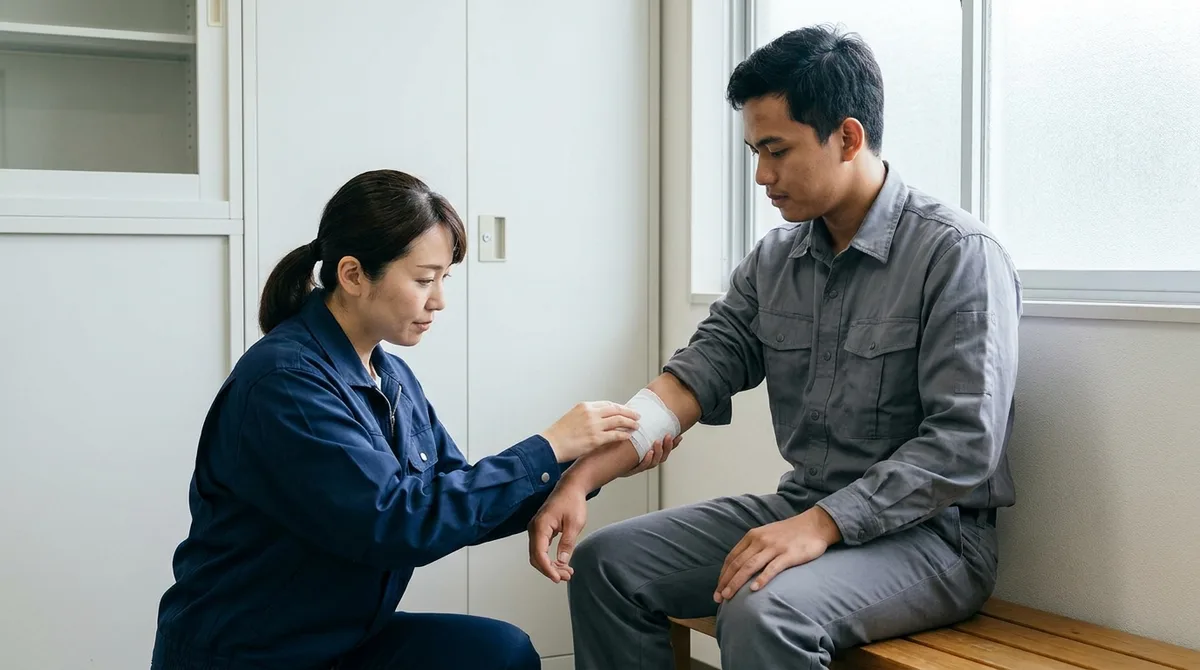
Japan's workers' accident compensation insurance (rosai hoken) covers foreign employees regardless of nationality. That includes people on work visas and students injured at a part time job. Treatment for an injury or illness caused by work or the commute is paid by this insurance rather than health insurance, and from the fourth day off work the worker receives 80% of their daily base amount for each day without pay.
Who is covered
The Ministry of Health, Labour and Welfare (MHLW) says so on the first page of its claims guidebook for foreign workers in Japan (PDF, Japanese edition): as long as a foreign national works in Japan, the insurance applies, and that includes accidents during a student's part time job. The premium is paid entirely by the employer (Osaka Labour Bureau, in Japanese), so nothing for it comes out of the worker's wages.
The guidebook also makes clear that health insurance cannot be used for a workplace injury. If you get hurt at work or on the way, tell the clinic at the start that it is a work related injury.
What the insurance pays
- Treatment: free at rosai hospitals and designated clinics. If you had no choice but to use another clinic, you pay first and claim the full amount back. Travel costs to the clinic can be covered too if conditions are met, generally a trip of 2 km or more each way.
- Time off: from the fourth day off, 80% of the daily base amount for each day without wages, made up of a 60% insurance benefit and a 20% special payment. The daily base amount is the wages for the three months before the accident divided by the number of calendar days in that period.
- Other benefits: payments for lasting disability, survivors' benefits, funeral costs and care benefits.
The guidebook gives a worked example. With a monthly wage of 200,000 yen and an accident in October, the daily base amount is about 6,522 yen, so about 5,217 yen is paid for each day off. The insurance pays nothing for the first three days off. For an injury at work, the employer has to pay compensation of 60% of average wages for those days; the law sets no such employer duty for commuting injuries.
Claims have a time limit. For treatment costs paid out of pocket and for time off benefits, the right to claim arises for each payment or each day off and expires two years from the following day.
If the worker returns home
Going home does not end every claim. According to the guidebook, benefits claimed from outside Japan are paid in yen converted at the exchange rate on the decision date, and treatment received abroad can be covered if it is judged appropriate. Some support exists only in Japan, such as aftercare, prosthetics and certain schooling support. Anyone planning to leave should ask the Labor Standards Inspection Office which benefits will continue before they go.
What the employer must do
When a worker dies or has to take time off because of a workplace accident, the employer must submit a report of worker death or injury to the Labor Standards Inspection Office without delay, under Article 100 of the Industrial Safety and Health Act and Article 97 of its regulations. Since January 1, 2025 the report's contents have changed and it must be filed electronically. Failing to file it, or filing a false one, is known as rosai kakushi, concealing a workplace accident, and can lead to a fine of up to 500,000 yen (Fukuoka Labour Bureau, in Japanese).
The claim forms also have a section where the employer certifies the date and circumstances of the accident. Asking an injured employee not to use the insurance, or to say the injury happened outside work, leaves the worker worse off and puts the company at real risk.
Dispatched workers
When a dispatched worker is injured, the staffing agency's workers' accident insurance applies. According to MHLW guidance for staffing agencies and client companies (PDF, in Japanese), both the agency and the client must file the death or injury report with their own inspection offices, and the client must send a copy of its report to the agency. The agency certifies the time, place and circumstances in the benefit claim, so the client needs to share the facts quickly. When Sincero Global is the dispatching agency, those agency duties are ours. Other dispatch rules are covered in our article on the three year rule.
Where to ask in Kanagawa
The Kanagawa Labour Bureau runs a Consultation Service for Foreign Workers in its Inspection Division in Yokohama, for questions about working conditions, workplace accidents and the insurance, with guides in English, Portuguese, Spanish, Vietnamese, Tagalog and Chinese. Safety training in a language the worker understands helps prevent accidents in the first place, and MHLW's free multilingual safety materials are listed in our article on plain Japanese at work.